
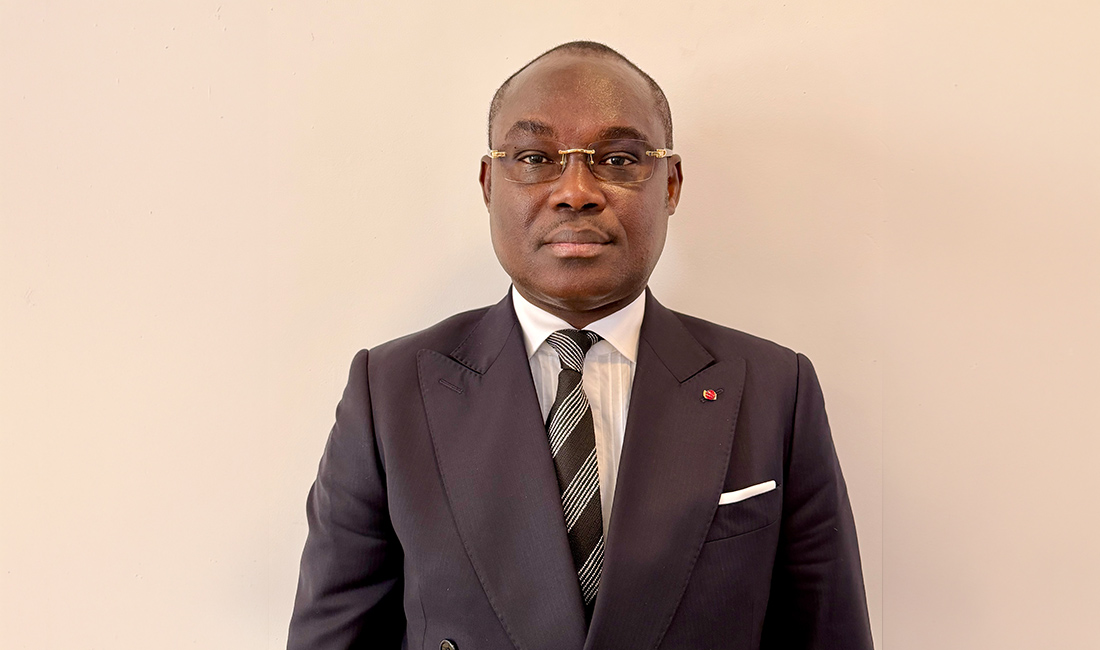
30 Sep Interview with H.E. Rufin Benam Beltoungou, Minister of Mines and Geology, Central African Republic
The Central African Republic (CAR) possesses one of the richest geological endowments in the region. How would you describe the current state of the mining and geology sector and its potential to shape the country’s economic future?
It is true that the CAR has considerable mineral resources, comparable to those of the Democratic Republic of the Congo. For a long time, this potential remained undervalued. But today, I can say that the sector is experiencing a phase of expansion, driven by reforms undertaken by President Faustin-Archange Touadéra. We began by overhauling the legal framework, rewriting the Mining Code, which now more clearly defines the conditions for investment and the mechanisms for cooperation with potential partners. This momentum is particularly evident in gold mining. Gold is present throughout the CAR and its production has now surpassed that of diamonds — long emblematic of the country. We are facing a sector undergoing profound reform and rapid expansion.
As the National Development Plan 2024-2028 (PND) sets out an ambitious vision for economic transformation, mining is positioned as a foundation for long-term recovery. Within this framework, what priority actions and projects are designed to transform CAR’s mineral wealth into a true engine of national development?
We have one of the richest mining heritages in Africa, but it must be said that this potential has never really been exploited. Today, the head of state’s top priority — as he has clearly stated in his manifesto and in various statements — is to deepen the country’s geological knowledge: to understand what the CAR has beneath its feet, where these resources are located and in what quantities. Unfortunately, this knowledge has been lacking since independence.
The only mining plan the CAR has ever had dates back to 1995, developed with the support of the World Bank, which identified more than 400 mineral deposits. Since then, no real effort has been made to explore or update geological data. Under the current impetus of the president, we have set up a geological and mining research unit: a team of geologists, divided by region and working almost like commandos, tasked with traveling throughout the territory to carry out preliminary prospecting work and strengthen our knowledge of the Central African subsoil. The CAR is gradually consolidating a more transparent mining framework, supported by mechanisms such as the Kimberley Process, in order to build confidence at the global level.
Thanks to this work, we have now identified more than 520 mineral occurrences and research is continuing. Several samples have been sent to international reference laboratories and the expected results should further refine and enrich this mapping of the CAR’s subsoil. Our goal, supported by various bilateral cooperation agreements and partnerships with internationally renowned companies, is now clear: to develop these resources.
The second priority stems from lessons learned from the experience of other African countries: local processing. Extracting minerals is one step, but processing them locally is the major challenge. In line with the Head of State’s vision, once resources have been identified and highlighted, the priority becomes their processing. The new mining code therefore includes the creation of processing units: structures dedicated to the development of diamonds via a national cutting facility and gold via a national refinery. These measures also respond to the recommendations of the republican dialogue, where participants called on the state to establish national companies and industrial capacities capable of creating real added value when exploiting our minerals.
With global demand for minerals rising, CAR is increasingly viewed as a promising destination for high-potential geological ventures. What recent improvements in CAR’s legal and regulatory framework have made the country more attractive to investors and which opportunities in the mining sector would you particularly like to highlight?
This process was really launched in 2017, when the president came to power. He asked the government to review the mining code in order to bring it into line with international best practices. The work began with the support of the African Development Bank, USAID and the African Legal Facility, which backed a diagnostic study of the old 2009 code. Following this study, we received support from the World Bank, which assisted a team of experts from the ministry. When I took office in 2021, I continued this work with these experts on the first draft of the text. With the support of a consultant provided by the World Bank, we refined the draft law. After a long process, in 2024 we succeeded in passing a new mining code, which is now considered a benchmark text. We included provisions designed to make our country more attractive to investors and to boost the mining sector. For example, under the old code, a company wishing to invest was required to pay a signing bonus before even starting its activities — a constraint that we reviewed to facilitate investment.
Today, we felt that this provision was a major obstacle to investment so we removed it. Similarly, the share of production going to the government — previously set at 15% of gross production — has been reduced from 10%. The government’s free equity stake in mining companies, which was also 15%, has been reduced to 10%. The objective is clear: to create a more attractive environment for the private sector and encourage new investors. Alongside these reforms to the mining code, we have implemented additional measures that are equally decisive.
Restoring security throughout the country has been a key factor. We have also developed a national gold development strategy, adopted by presidential decree, to guide and structure the development of this sector. I believe that the CAR has now become one of the most attractive countries in the region — and potentially in the world — for mining, both in terms of the clarity of its regulatory framework and the wealth of its subsoil resources. Indeed, the work carried out by our geological and mining research units has revealed new strategic resources, including critical minerals such as cobalt, coltan, lithium, and nickel.
CAR is steadily consolidating a foundation for a more transparent mining framework, supported by mechanisms such as the Kimberley Process to bolster global trust. How is the Ministry advancing these efforts in the sector to reinforce stability and promote responsible practices?
The CAR is one of the founding members of the Kimberley Process. In fact, we have been one of the countries that has best implemented this mechanism. The suspension in 2013 was not related to non-compliance with KP rules, but solely to the breakdown of constitutional order. For more than ten years, the government has been working to enable the country to regain its place within the Kimberley Process. The sanction was lifted last year and all member states recognized our country’s efforts to implement the mechanism. I can even say that the CAR has gone beyond simply participating: it now contributes to assessments carried out in other countries.
Recently, the director general of the Kimberley Process, based in Bangui, was invited by the Great Lakes Regional Collaboration in Botswana to share KP best practices with the countries of the Great Lakes region, of which we ourselves are a part, in order to strengthen the implementation of certification. In the Great Lakes countries, certain minerals — such as gold, cassiterite, tungsten and other substances — are subject to strict certification requirements. For this reason, the member states of the International Conference on the Great Lakes Region asked the CAR to send this expert to explain and teach them how to implement the Kimberley Process. This clearly demonstrates that our country does not merely comply with the rules of the Kimberley Process: it also applies best practices, to the point where it is now recognized as a model for implementation.
Recent engagements, including the Luanda Summit, have marked a new phase in CAR’s dialogue with global partners and highlighted growing US interest in strategic minerals. How do you envision cooperation with the United States advancing over the coming years in the fields of mining and geological development?
From the outset of our discussion on the mining code, we received support from the United States, through USAID, for the preliminary study of the code. USAID also supported us when we worked to regain our place in the Kimberley Process, providing valuable technical assistance. With the United States — and the president reiterated this by emphasizing that there is room for everyone — we believe that there are real opportunities for collaboration.
About two months ago, I received the deputy chief of mission from the US Embassy, who was here on an official visit. We discussed topics of mutual interest to our two countries, particularly in the mining sector, where some American companies are currently exploring the possibility of investing in the CAR. I informed him of the CAR’s willingness to engage with these companies, whether in Bangui, in the United States, or via videoconference, in order to explore opportunities that could lead them to invest in our country. In the current context of energy transition, I believe that the United States has a particular interest in several of our minerals such as cobalt, coltan, nickel and lithium — which are available in the CAR. We will be delighted to welcome American companies wishing to invest in the CAR.
Under your leadership, the mining sector is becoming a pillar of economic growth and sustainable development. Looking ahead to 2028 and beyond, what is your vision for the sector’s growth and impact on CAR’s future?
The vision is primarily that of the head of state, who has always expressed his desire to attract foreign direct investment in order to stimulate national development, create jobs for young people and mobilize resources for the benefit of the country. Attracting these investments requires not only an attractive legal framework, but also an effective fight against corruption, the establishment of exemplary governance and the reduction of fraud and smuggling. This is precisely what we are working on.
Moreover, as part of the new mining code, we have transformed the former special anti-fraud unit — previously focused on enforcement in the diamond sector — into a mining police force with expanded powers, responsible for protecting the entire Central African mining sector. These teams are currently being deployed and will be fully operational throughout the country to ensure the security of the sector and guarantee that investors comply with best practices. Internally, the vision is also based on the local processing of our resources, particularly gold and other minerals. It is this processing that generates added value and creates wealth.
In the longer term, the ambition is to deepen our knowledge of our geological heritage, which many describe as a “geological scandal”. Our goal is to know precisely what nature has made available to the Central African people. In the coming years, we want to stop talking about mining indices and start talking about proven reserves. It is in this sense that the president insists on the need to improve our country’s geological knowledge.
What final message would you like to share with USA Today readers about CAR as a land of opportunities for investment, innovation and development?
The Central African Republic is a democratic country where freedom of trade, industry and movement prevail. Any investor can come here with complete peace of mind. Within the framework of the Economic and Monetary Community of Central Africa, of which we are a member, foreign exchange regulations allow investors to freely transfer their profits. This principle is also enshrined in the Mining Code: the state does not impose any withholding taxes or prevent any investment initiatives. We would therefore like to take advantage of the platform you offer us to invite all your readers, as well as the business leaders who follow your newspaper, to consider the CAR: we are ready to welcome them with open arms.
Sorry, the comment form is closed at this time.