
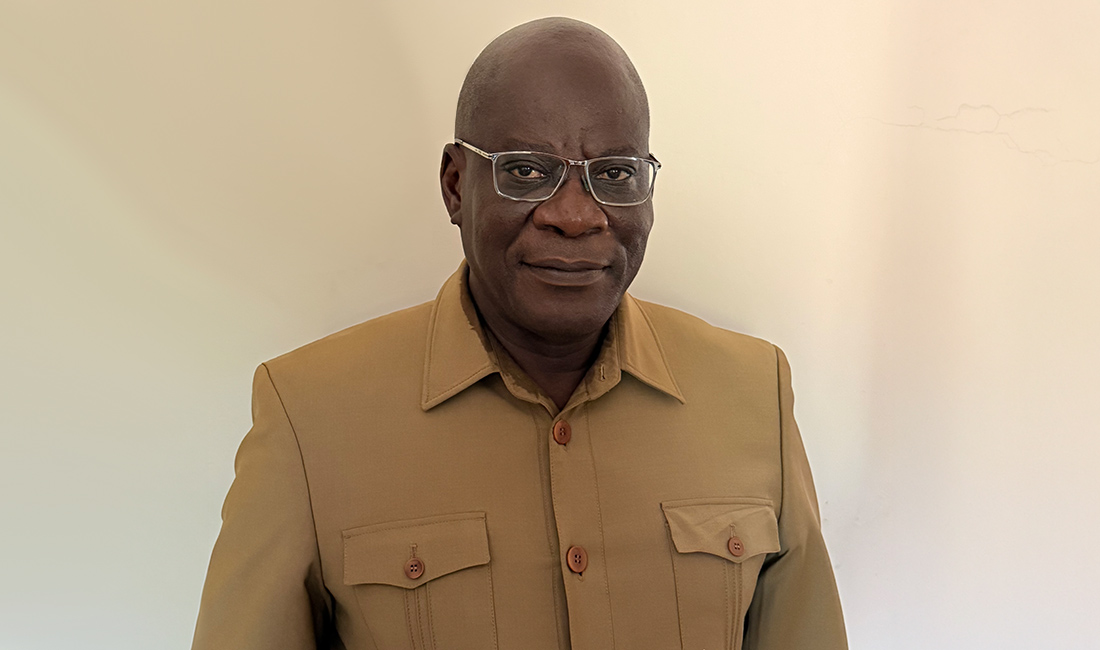
01 Oct Interview with Hon. Richard Filakota, Minister of Economy, Planning and International Cooperation, CAR
CAR is at a defining moment with reforms, rising investor interest and a bold national vision opening new opportunities. How would you assess CAR’s economy and its potential today?
This economy is both undergoing a revival and undergoing major changes. When I say revival, I mean that the Central African economy is rising from the ashes. This economy has come a long way and is beginning to find its footing, first in the primary sector, then in the secondary sector, which is much more marked by the resumption of natural resource exploitation. When I say natural resources, I am referring mainly to mining and agriculture, to name just two sectors.
The CAR was suspended from the Kimberley Process in 2013 due to the armed conflicts that had broken out in the country. But in November 2024, the process lifted the embargo on the exploitation of Central African diamonds, allowing the mining sector to resume normal operations, with positive repercussions for the Central African economy.
In the agricultural sector, we are also seeing a significant recovery in agricultural production across the Central African Republic. What is new in this sector is the significant increase in agricultural land, with increasingly large farms and cooperatives mobilizing to cultivate large areas with the support of international institutions such as the World Bank, the African Development Bank and the European Union, which are investing heavily in the agricultural sector. In terms of change, it could be said that the Central African economy has placed particular emphasis on the processing of these raw materials from mines, i.e., gold and diamonds. Today, we are seeing companies and cooperatives being set up in the mining sector that are focused on the exploitation and processing of gold and diamonds. Instead of importing them in their raw form, they are now beginning to recognize the added value of processing these raw materials locally before marketing them.
On the agricultural side, we are now seeing a rise in agribusiness, with entrepreneurs, both men and women, in both urban and rural areas, investing increasingly in agribusiness. This is because we are seeing their turnover reaching quite interesting levels which shows that this sector is starting to become dynamic. With the arrival of large industrial groups, for example, who want to invest in the CAR, for example India has signed a partnership agreement with the CAR for the cultivation, production and marketing of cassava, as well as the cultivation, production and marketing of sugar cane. They will be cultivating large areas of land. All of this will boost the agricultural sector through industrial-scale production and processing. From a circular economy, essentially focused inward, toward the internal needs of the Central African people, to a competitive economy, focused outward, starting with the Central African sub-region, the Central African economy is indeed in this dynamic of both revival and profound change.
We must also add to this the road corridors. Road corridors play an important role in this transformation of the Central African economy because they are the lifeblood of the economy. These corridors will connect agricultural basins to markets, while also facilitating regional trade and reducing transportation costs. The CAR is a landlocked country and only corridors can open up this 240,000-square-mile-territory and allow both goods and people to circulate. Every section we rehabilitate from Bangui to the Cameroon border, to the Sudan border, to the Chad or Congo border, saves time which saves money. It also allows us to reduce the risks associated with products moving more freely between these borders and to generate competitive margins.
The National Development Plan 2024-2028 sets an ambitious course for structural change and long-term prosperity. What is the core vision behind the PND and what early results is it already showing?
The central vision of the PND desired by the CAR’s highest authorities, in particular the president and head of state, Professor Faustin-Archange Touadéra, is to implement public policies, but not just any public policies. Public policies capable of lifting the vast majority of the Central African population out of poverty on the one hand and on the other hand, setting the CAR on the path to sustainable development. We have gone through phases of crisis and resilience and today we are embarking on the sustainable development of this country and so, the PND is, in a way, the vehicle, the engine that will enable us to make this shift towards true development.
Ambitiously, the PND 2024-2028, throughout this programmatic journey, aims, among other things, to achieve average annual GDP growth of between 3 and 4.2% between 2024 and 2028. It also aims to reduce the incidence of poverty from 68.8% in 2021 to 62% in 2028, i.e., within three years and to reduce the infant and child mortality rate from 99 per thousand which was already in 2023, to 45 per thousand by 2028.
Finally it aims to improve the population’s access to water and electricity from 14% in 2023 to 30% in 2028. This means that the vision embodied by the PND aims to make the CAR a prosperous country with high-quality human capital and resilient, sustainable infrastructure, based on an inclusive rule of law, that also respects the law and the principles of good governance in order to contribute to the achievement of what we have already included in this national development plan, known as the five strategic priorities. The PND is therefore based on five strategic priorities.
The first priority is to strengthen security, national reconciliation, the promotion of good governance and the rule of law. The second pillar is the development of quality human capital and facilitating equitable access for the population to the best basic social services, meaning water, electricity, health, etc. The third pillar is the development of resilient and sustainable infrastructure, meaning corridors, but there is also energy and everything related to roads, bridges, ports, dry ports and deep-water ports. The fourth axis is the acceleration of production and the development of value chains in productive sectors with a view to strong, inclusive and sustainable economic growth. Alongside that, there is also the flourishing trade that is linked to these production areas and will enable the economy to develop. Finally, the fifth priority is environmental sustainability. How can we develop a country as green as the CAR while harnessing its full potential in terms of forestry?
CAR is implementing strategic projects across multiple sectors to strengthen the economy: from major energy initiatives to new transport, digital and agricultural programs. What are the main economic priorities the ministry is focusing on today and how are they aligned with CAR’s broader development vision?
The PND is part of an integrated system where roads, energy, agribusiness, digital technology and logistics are interlinked. All of this comes together to create a dynamic for growth. They are the lifeblood of the economy, connecting the agricultural basin to the market. At the same time, they facilitate regional trade and reduce transportation costs. Alongside roads, there is also the issue of energy. We closely associate energy with roads because electricity production increases productive activities at the level of mining, agriculture and commerce. Energy therefore also plays a key role in the industrialization of the CAR. You can see, for example, the impact of energy industrialization in the cold chain, which is operating at the level of SMEs and SMIs, which are investing more and more in this sector, but there are also health centers that are open and allow people to work 24 hours a day. It is energy that makes it possible to easily increase the capacity of these activities.
These infrastructures also attract what are known as productive value chains, agriculture and agribusiness. This is at the heart of our strategy, because we need to process locally what was previously exported in its raw form. Standardizing, packaging and storing are now part of the challenges we face. We hope that each processing unit will create more jobs and more income for the rural population and we will now conquer regional markets.
Added to this are bridges to facilitate the urbanization of the capital. We have plans to build a bridge over the Ubangi River to connect the CAR and the Democratic Republic of Congo. And that ties in somewhat with the European Union’s Agenda 2063. These are projects that reduce uncertainty and will accelerate trade.
Digitalization has become one of the top national priorities, with CAR investing in its digital backbone. How would you describe the progress of digitalization so far, what challenges remain and how is the government addressing them to ensure lasting benefits?
I can summarize the objectives of digitization in the CAR in five points. The first point is the modernization of public administration. The second point is that digitization will increase the state’s tax revenues. Thirdly, it will improve transparency and governance at all levels. The fourth point is that it is a tool that will greatly enable us to develop financial inclusion. And finally, digitization will create economic opportunities at all levels, from the top of the state to the bottom of the ladder. It will really create significant economic momentum. Starting with digital technology, this complements the integrated system that already exists in the PND but it will make the PND’s integrated system more efficient and improve the living conditions of the Central African people, starting with the modernization of public administration. Financial services have already begun to use technological innovations to improve transparency and increase government revenues. That is something very important.
Beyond finance, there is an ongoing project to promote national digital identity. In the CAR, we already have a population of 6 million. We need to identify these people and organize databases so that we can manage them better. All of this is a challenge that can be met through digitization. But we also need to think about dematerializing administrative procedures, because we waste a lot of time on administrative files, registrations, etc. With digitization, I think we will do some very interesting work and save a lot of time. In terms of mobile phone services, online payments, e-banking and new information and communication technologies, there is a real acceleration effect that has already begun in the CAR and this has led to a boom in economic activity thanks to these tools that we are beginning to experiment with.
The major challenges are connectivity infrastructures. Internet access is currently something of a luxury. Not everyone has access to the Internet and the internet’s functioning is linked to energy. When there is no energy, there are untimely power cuts. This also affects what we call connectivity continuity. The country is fighting its way through a fiber optic project that is already underway and will continue to serve not only the capital but also the hinterland. All of this will enable us to have high-quality connectivity infrastructure to meet the needs of the population.
As a “laboratory” for economic promotion, the Ministry is driving CAR’s integration through AfCFTA and initiatives like the African Caucus in Bangui. How do these platforms support CAR’s development strategy and expand trade and investment?
As a landlocked country, we are not connected to other countries by sea, but we are connected by a few corridors on the northwest side that link us to Cameroon. And through Cameroon, we can reach the sea. There is also a new corridor called CD 13 that is currently connecting us to the Republic of Congo-Brazzaville. To connect us to the port of Pointe Noire, all these efforts in terms of road infrastructure, which are also accompanied by port infrastructure, will enable this country to meet the challenges of regional and international trade. The CAR is a country with enormous potential in terms of natural resources, but also potential in terms of human capital, potential in terms of the geostrategic position of the CAR, which is located at the very heart of the African continent.
Surrounding this country, you have practically the countries of the North, the countries of the South, the countries of the East and then the West. So, the CAR is the geographical junction of all these countries. It is even the very heart of the African Continental Free Trade Agreement (AfCFTA). The very heart of the AfCFTA lies in the cities of the Central African Republic. All the work is currently underway to ensure that the CAR, through everything that is being done within the framework of the African Union and Economic and Monetary Community of Central Africa so that our participation in the issue of the dynamics of the AfCFTA can enable us to be an important and significant player.
CAR is strengthening its ties with the United States, as part of broader US commitments of over $2.5 billion to Africa and is attracting increasing interest from American investors. How is the Ministry positioning CAR as an attractive destination for US investors and what opportunities do you see for expanding this partnership in the coming years?
The good news is that when we launched the PND, we immediately received a kind of collective endorsement from international opinion, the international community and the United States, which congratulated us on the development and publication of the national development plan. Then, based on the PND, we launched the challenge of opening up the country to all investors, whether European, American, Asian, or African, so that the country could become a place of give and take. How can we receive what others have in terms of financing, experience and skills transfer and with all our potential — natural, mining, hydraulic, geostrategic — how can we also exchange this with others? It was in this context, when we gathered in Casablanca, Morocco, to organize the round table to which many American investors responded.
Among those who signed partnership agreements with the CAR are American investors. They are more interested in the mining sector, the energy production sector and energy production. I also believe that some are interested in road infrastructure. It is really the main areas of our national development plan that are of real interest to American investors and we are happy today to see this return of the United States to the CAR through the PND, but also through win-win cooperation.
Since taking office, you’ve led CAR through one of the most ambitious economic transformations the country has seen. Looking back, what achievements are you personally most proud of in your journey as Minister and speaking of the future, what is your vision for CAR’s economy and its role in the region and continent through 2028 and beyond?
The work I have done alongside the president is, first and foremost, to have worked hard in the context of the republican dialogue that took place in 2023 and which enabled this country to bring its sons and daughters together around issues of reconciliation, peace and development. I believe that we have almost succeeded in this challenge, because this dialogue went very well under the authority of the president, but it was I who chaired all the work until the end. The second thing was the organization and management of the PND and the organization of the roundtable, which was a success. It is a collective effort, but much of the work has been done by the Ministry of Economy, Planning and International Cooperation.
We are proud to see that the national development plan has received the support of more than 700 people who participated in the roundtable discussion and that $9 billion in funding was raised during this roundtable. So, for me, this is a source of satisfaction and pride and a job well done that I really want to share. I believe that it gives us the confidence to invest even more so that we can translate these financial commitments and proposals into reality through development, through change and through profound economic and developmental transformations.
The CAR is back on the international stage and wants to offer all investors from the north, south, east and west immeasurable opportunities in engineering, processing, exploitation and marketing of natural resources. Our country has a great deal to share with the world and we are ready to welcome those who want to work with us.
Sorry, the comment form is closed at this time.