
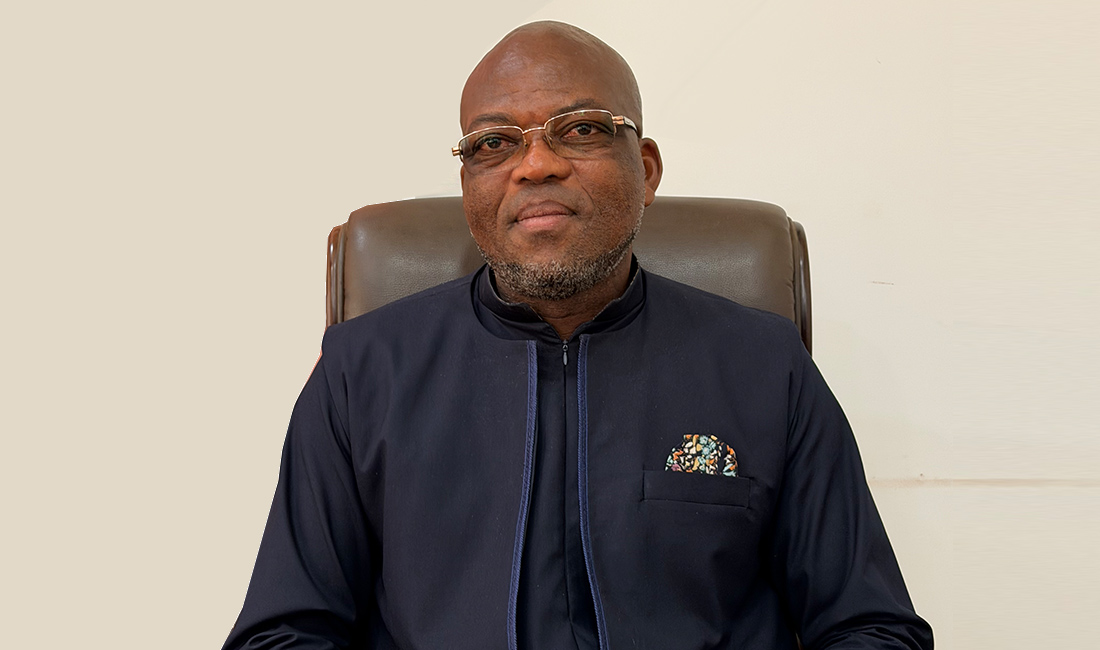
01 Oct Interview with S. E. Thierry Patrick Akoloza, Minister of Commerce and Industry, CAR
Today, the Ministry of Commerce and Industry is one of the main drivers of CAR’s economic revitalization, with key initiatives such as the creation of a Special Economic Zone along the Boali road. How would you describe the current landscape of CAR’s commerce and industry and what key advantages are laying the foundation for the country’s industrial development?
The development of trade and industry is a priority for the Central African government. It is true that in the area of trade, the country imports more products than it exports, precisely because our industrial base is very weak and in deficit. In terms of trade, the country does not trade much. This is precisely because our industrial base is very weak. The government is making a lot of efforts to breathe new life into the industrial sector through, such as through the creation of special economic zones.
This is a very important project for the government because, as part of the implementation of economic zones and continental free trade areas, we need to develop our industry, which will enable us to market and process our local products. The CAR’s assets are not only its natural resources such as cotton, wood, diamonds and gold. We have also made considerable efforts in terms of the business environment and decision-making frameworks. We also have an investment charter that offers opportunities to investors in the CAR.
As an ambitious vision for economic transformation, the National Development Plan (PND) 2024-2028 calls for stronger competitiveness and private-sector expansion. What reforms and initiatives are the Ministry advancing to put the NDP’s priorities into action for trade and industry?
In the case of the PND, the Central African government’s top priority is road and energy infrastructure. You can’t talk about development without talking about energy and roads. In terms of reforms, many reforms are being implemented. First, on the legal front in the industrial sector, in June 2024, for the first time since our country’s independence, the CAR adopted a law on the industrial sector. This is already a very important reform. Secondly, the investment charter offers many tax and customs advantages to investors and setting up a business has now become flexible. Even the rate set at the time at several million francs has now been reduced to less than $200 which is all you need to set up your own business. The time required to set up a business through the one-stop shop is five days but it used to take months to set up a business.
These are conditions within the framework of the reforms we are making for the NDP, because at the departmental level, the flagship project, we are making reforms. Why? To attract lots of investors by creating special economic zones and agri-food laboratories and resuming construction work on the cement plants in Zila and Boubassa. We are doing everything we can to ensure that the PND becomes a real tool for development in the CAR.
CAR’s exports, from gold and timber to diamonds, are evolving alongside deeper integration within the Economic Community of Central African States and the Economic and Monetary Community of Central Africa (CEMAC). How is the Ministry fostering export expansion and enhancing the country’s role in regional and global trade?
Already, in terms of exports, resources such as wood, diamonds and others, we export these products in their raw form and we believe that this is not beneficial for our country. We want these products to be processed first within the value chain. In this regard, as part of the implementation of the African Continental Free Trade Area (AfCFTA) project, certain sectors have been identified, notably the timber sector, which today, in principle, should not be exported in its raw form. The creation of these economic zones is intended to increase the flow of exports of our products, because if we do not export products in large quantities, i.e., we do not trade with countries in the region and trade continues to accounts for 1% of trade flows between the CAR and countries in the CEMAC subregions, our country’s resources depend on tax and customs revenues. Further, if we move towards implementing the AfCFTA and don’t opt out, we will be flooded with products coming from elsewhere. That is why we are working toward the 2030 goal of enabling our country to export and significantly reduce imports, because a country that lives off imports becomes poorer.
That is why the government, through the Ministry of Trade, with the support of its partners, is working to develop our exports. Mechanisms are also being put in place to boost the export of our products. But these products need to be processed to increase their value. When logs are exported, if they are processed, they increase in value and generate considerable revenue for the CAR, which faces many development challenges.
Expanding industrial activity is crucial for advancing economic diversification and moving beyond raw-material exports. What strategies are being implemented to strengthen the growth and competitiveness of CAR’s manufacturers and SMEs?
First, for manufacturers we are already providing support by strengthening their capacities, supporting them to enable them to strengthen their capacities to be more competitive nationally and internationally. Secondly, the real difficulty for our SMEs is access to financing, so the government, through its partners, has set up a guarantee fund that is currently being operationalized. If this guarantee fund becomes operational, it will help our small and medium-sized enterprises to be more competitive. There are many that have been identified, but the real challenge is financing. That is why, in our meetings with partners, we are advocating for the implementation of this guarantee fund project to enable our SMEs to be competitive.
Within the framework of the WTO, of which we are a member, in negotiations, it is absolutely essential that our SMEs’ operational capacity be strengthened so that local products can be sold abroad. And this also contributes to the country’s image in economic terms.
With new channels of cooperation emerging, including the launch of the “Forum on Investment and Partnerships” in Bangui, investment partnerships are central to unlocking CAR’s potential. What is the Ministry’s stance on attracting foreign investment and facilitating strategic partnerships?
First, the organization. The code of this forum attests to the fact that peace has returned to the country. Before the forum, we organized the caucus in the CAR, which was attended by many prominent businessmen. This forum is an opportunity for the CAR to promote its economic potential and business opportunities, which is what the Ministry of Trade and Industry did during the presentation I gave as Minister of Trade and Industry to reassure investors that the climate is now favorable for investing in the country.
First, the primary advantage is the return of peace. Second is the business climate. Third is the investor charter. It is a very favorable investment for investors, with very attractive conditions. The fourth factor is the formalization of businesses. Our forests, even in the agricultural sector, we have 15,000 hectares of arable land that is not being used. With the return of peace, investors have everything to gain by coming to invest in the Central African Republic. As I said, these companies can be set up in five days, in a week and a company can already be established and start investing. However, what we ask is that the national laws governing investment in the CAR be respected.
As a dynamic leader driving CAR’s transformation, you play a key role in shaping the country’s future. Looking ahead, what is your long-term vision for trade and industry and how do you see these sectors influencing CAR’s economic trajectory?
Every country in the world that has developed has done so through industry and a country like ours, which has considerable assets, even natural ones, has lost a lot of time in crises and in war. It is important that by 2030, our country be transformed through industry. That is the battle we are fighting, the battle of the government, the battle of the ministry and the vision of the president.
It is also the African Union’s 2030 agenda because by 2030, we need to be able to trade with every country in the world. But in order to trade, we need to transform. So, through industrialization, the Ministry of Trade, the Ministry of Energy, the Ministry of Agriculture, Water and Forests all need to work together. If all this potential is not transformed, there is no wealth.
What we are doing with great determination is industrializing our country. That is why I said at the beginning that the government’s priority, in the context of industrializing our country and within the framework of the NDP, is road infrastructure and energy. If we have the energy — and the government is making a lot of effort, today, megawatts are increasing more and more to enable investors, as part of the establishment of this economic zone.
The pilot site we have identified is at the source of our country’s energy, in Boali, because that is where the turbines are located, so we want to establish this economic zone here to ensure that the companies that set up here will not have any difficulty in terms of energy supply, roads and also the section with Cameroon, through the Bangui-Douala corridor. It is important that we work quickly with our partners to create this zone and industrialize our country. What are the advantages? First, in terms of taxation and second, to reduce unemployment and create jobs. And if we create jobs, social peace will be fully restored because young people and women will not be tempted to join armed groups. When young people and women can’t find anything to do, they are tempted to turn to what we deplore, taking up arms.
What final message would you like to share with USA Today readers about CAR as a land of opportunities for investment, innovation and development?
One message: peace has been restored in the CAR. Ten years ago the country was uninhabitable because there was violence everywhere. Today, peace has been restored. As the saying goes, money doesn’t like noise. There is no more noise, money can now circulate. I invite all investors. and I am pleased that in recent years, investors have been flocking to the CAR because we have created not only secure conditions, but also the institutional and legal conditions for business creation, so investors cannot hesitate for a moment to come. In fact, we have signed many protocols of agreement with certain commercial partners who have come to see the realities of our country today for themselves. I invite partners not to hesitate to come to the CAR. They have everything to gain.
Sorry, the comment form is closed at this time.